Would you like to switch to the accessible version of this site?

Go to accessible site Close modal window

Don't need the accessible version of this site?

Hide the accessibility button Close modal window
Accessibility View Close toolbar

(816) 246-7779

Request Appointment
text
Menu
  • Home
  • Eyecare Services
    • Contact Lens Exams
    • Eye & Vision Exams
    • LASIK Eye Surgery
    • Eye Surgery
    • Hard To Fit Contacts
    • Computer Vision Treatment
    • Sunglasses
  • Features
  • New Patient Center
    • Online Forms
    • Insurance & Payments
  • Insurance/Open Access
  • COVID-19
  • Contact Us
    • Appointment Request
  • Meet The Doctors
  • About Your Eyes
    • What is a Certified Paraoptometric
    • What is a Doctor of Optometry
    • LASIK for Vision Correction
    • Vision Conditions
    • Eye Diseases
  • About Us
  • Frames
  • Lens Menu
  • Testimonials
  • Community Content
    • Common Eye Conditions
      • Age-Related
      • Cognitive and Acquired
      • Vision Impairment
      • Injury & Irritation
      • Eye Lids
      • Changes in Appearance
    • Contact Lenses
    • Eye Diseases
    • Eyeglasses
      • Eyeglass Lenses
    • Eye Symptoms
    • Tips and Tricks
    • How the Eyes Work
      • Basic Visual Skills
    • Pediatric Vision
    • Protecting Your Eyes
    • Visual Rehabilitation
    • Vision Problems
    • What is Vision Therapy
    • Vision Therapy Programs
    • We Can Help With
      • Cataracts
      • Corneal Disorders
        • Disorders
      • Glaucoma
      • Refractive Disorders
      • Adult Strabismus
      • Retinal Disorders
    • Newsletters
      • Glasses & Frames
      • Contacts
      • Kid's Vision
      • Conditions That Affect Vision
      • Tips for Healthy Eyes
      • Amazing, Interesting Eyes
      • Medical Perspectives
Envision Eyecare
  • Home >
  • Articles >
  • Newsletters >
  • Conditions That Affect Vision >
  • Strabismus

Strabismus

  • Created in Newsletters, Conditions That Affect Vision
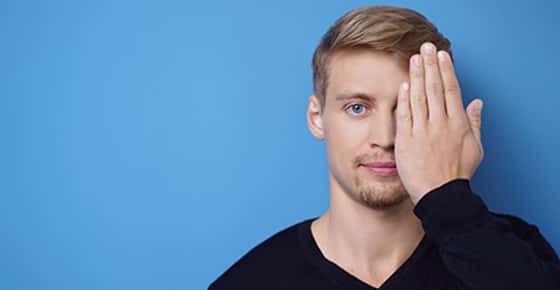
Image of man covering one eye.

Strabismus is the medical term for the misalignment of the eyes. Commonly referred to as cross-eyed or wall-eyed, strabismus may involve either one or both eyes turning inward, outward or even up or down. It is one of the most common vision conditions in young children, affecting somewhere between 2 and 4 percent of the population.

Symptoms of strabismus typically reveal themselves in children between the ages of 1 and 4. In some cases, children with strabismus experience double vision or low vision in general, and those who may be too young to vocalize their discomfort may tilt their heads or squint frequently. Many children will not report vision problems on their own and, typically, parents or teachers notice a misalignment of the eyes.

What Causes Strabismus?

Strabismus can have many different causes. In particular, strabismus is often caused by abnormal functioning of: the part of the brain that controls eye movements, the nerves that transmit signals to the muscles or the eye muscles themselves. It can also be caused by certain general health problems, eye conditions, head injuries, refractive errors or, in part, family history.

Types of Strabismus

Common types of strabismus include the following:

Esotropia is the most common cause of childhood strabismus. It tends to appear very early on in a person’s life — primarily occurring in infants — and involves one eye turning inward, toward the nose, instead of aligning with the second eye and looking straight ahead.

Exotropia often appears in children between the ages of 1 and 6. Exotropia occurs when one eye turns outward, away from the nose. This type of strabismus is commonly referred to as walleye.

Hypertropia is considered the least common form of strabismus. This form of strabismus, also referred to as vertical deviation, is characterized by one eye turning upward, toward the eyebrow.

Strabismus Treatment Options

Treatment for strabismus is tailored to address the initial source of the problem and can vary depending on the severity of the eye misalignment.

One of the most common treatments for strabismus is eye patching. If the same eye consistently turns in the same direction, a patch may be placed over the regularly functioning eye. In this way, patching may be used to train the weaker eye to do the “seeing” work in place of the stronger eye. Patches block out all light and, over time, may strengthen the eye and restore alignment. Depending on the case, children may be recommended to wear a patch anywhere from only a few hours a day to, occasionally, more than six hours each day.

How Vision Therapy Can Help With Strabismus

Vision therapy involves an individualized, non-surgical treatment program that is designed to help correct or improve certain eye conditions, including strabismus. Treatment will vary, depending on the eye condition and the patient’s unique visual needs. Specific exercises — including ones that address eye alignment, eye teaming, focusing abilities and more — can be used to help manage strabismus and realign the eyes.

  • Common Eye Conditions
    • Age-Related
    • Cognitive and Acquired
    • Vision Impairment
    • Injury & Irritation
    • Eye Lids
    • Changes in Appearance
  • Contact Lenses
  • Eye Diseases
  • Eyeglasses
    • Eyeglass Lenses
  • Eye Symptoms
  • Tips and Tricks
  • How the Eyes Work
    • Basic Visual Skills
  • Pediatric Vision
  • Protecting Your Eyes
  • Visual Rehabilitation
  • Vision Problems
  • What is Vision Therapy
  • Vision Therapy Programs
  • We Can Help With
    • Cataracts
    • Corneal Disorders
      • Disorders
    • Glaucoma
    • Refractive Disorders
    • Adult Strabismus
    • Retinal Disorders
  • Newsletters
    • Glasses & Frames
    • Contacts
    • Kid's Vision
    • Conditions That Affect Vision
    • Tips for Healthy Eyes
    • Amazing, Interesting Eyes
    • Medical Perspectives

Lees Summit Office

Monday:

8:30 am-5:30 pm

Tuesday:

9:00 am-5:00 pm

Wednesday:

8:30 am-5:30 pm

Thursday:

9:00 am-7:00 pm

Friday:

8:30 am-12:30 pm

Saturday:

8:30am-12:30pm Alternating Saturdays

Sunday:

Closed

Exclusive Offer

Receive Up to $100 OFF a Second Pair Of Complete Glasses!

Feel Free to Contact Us!

Error!

    • Copyright © 2026 MH Sub I, LLC dba iMatrix.
    • Admin Log In
    • Site Map